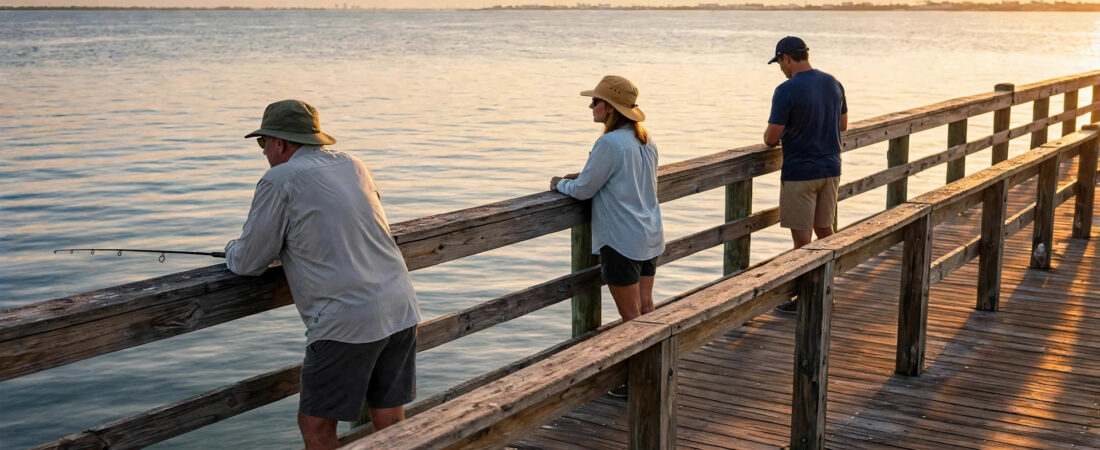
If you want to catch saltwater fish in Florida and you don’t have a boat, start on a pier. No launch ramp, no fuel bill, no trailer to back down anything — just a rod, a bucket of shrimp, and a long wooden walkway over some of the fishiest water in the state. Piers sit on structure, and structure holds fish. This guide covers what you’ll catch, the gear you actually need, the rigs that work, and how to fish the boards.
For the day’s tides, water temps, and what’s biting near you, check today’s Florida fishing report.
Why the Pier Is the Easiest First Cast in Florida
A pier does three things for a beginner. First, it puts you over deep water and structure without a boat — the pilings are covered in barnacles and oysters, and that growth feeds shrimp, crabs, and baitfish, which feed everything you’d want to catch. Second, most Florida piers are open from early morning into the evening — many around the clock in season — so you fish on your schedule. Third, the cost of entry is a pier admission fee and a bag of shrimp. Rental rods at the pier house, a bait shop right there, cleaning stations — the whole setup is built for somebody’s first saltwater trip.
There’s one more advantage nobody mentions: piers are classrooms. Fish next to the regulars and watch what they throw and where they throw it — you’ll learn more in a morning than a month of videos.
What You’ll Catch From a Florida Pier
The cast of characters changes with the seasons, but there’s almost always something willing to bite:
- Late winter into spring: Sheepshead stack up on the pilings, chewing barnacles and fiddler crabs — fussy biters and some of the best eating on the pier. Spanish mackerel arrive with the bait schools, and pompano start showing in the surf-side troughs along Gulf piers.
- Summer: Mangrove snapper move onto the pilings and under the pier in numbers — this is their season. Snook shadow the light lines and pilings at dawn, dusk, and night. Tarpon roll through near passes and the pier ends.
- Fall: Spanish mackerel run again, bluefish slash through bait pods, flounder settle along the sandy edges, and the mullet run pushes redfish and everything else tight to the beach and piers.
- Winter: Sheepshead take over the pilings, speckled trout slide into the deeper water around pier ends and passes, and whiting and black drum fill the cooler on shrimp fished on the bottom.
Year-round, add pinfish, grunts, small jacks, and catfish — plus the occasional surprise that reminds you you’re fishing the ocean.
The Beginner Pier Kit
You need less than you think:
- One combo to start: a medium-heavy pier spinning combo, 7½ to 8 feet with a 4000- or 5000-size reel. The length keeps your line clear of the pilings, and the backbone handles a surprise drum or snook that a light rod won’t.
- Line and leader: 20-pound braided line on the reel, and never fish it bare — tie on a few feet of 30-pound fluorocarbon leader. Barnacle-covered pilings cut braid like thread, and the leader is what survives the rub.
- A pier net — non-negotiable: a pier and bridge landing net, a hoop net on a long rope that you lower to the water. The deck sits 10 to 20 feet above the water, and you cannot lift a good fish that far — try it with a nice snapper and you’ll donate it back. The net also lowers released fish back down gently.
- A way to haul it: a pier fishing cart with rod holders turns the long walk down the boards into one trip, and a rolling cooler with ice keeps the catch and the drinks cold in Florida heat.
- Bait gear: a bait bucket with a battery aerator keeps live shrimp lively, and a small 5-foot cast net lets you gather bait where the pier’s rules allow it (many piers restrict cast-netting to certain areas or ban it — check before you throw).
- Tools and basics: saltwater fishing pliers for hooks and line, a small first-aid kit — pier hooks and fish spines find beginners — and serious sunscreen. Reflected sun off the water burns fast, and there’s no shade at the rail.
Rigs and Bait That Actually Work
Four setups cover nearly everything that swims past a pier:
- The bottom rig. A 2/0 or 3/0 circle hook on a fluorocarbon leader with just enough weight to hold bottom — a pyramid sinker in sand, an egg sinker where it’ll roll free. This is the snapper, drum, whiting, and sheepshead rig. Fish it close to the pilings, not out in the middle of nowhere.
- The jig. A ¼- to ⅜-ounce jig head with a soft plastic shrimp, worked slowly along the shadow line and under the pier, catches trout, snook, flounder, and snapper. Slow is the whole secret — drag it, hop it, let it sit.
- Free-lined live bait. A live shrimp or small baitfish on a circle hook with no weight, drifted with the current along the pilings, is how pier anglers connect with snook and mangrove snapper. Let it swim; don’t steer it.
- The popping cork. A popping cork over a live shrimp, fished along the outside pilings, calls in speckled trout like a dinner bell.
And keep sabiki rigs handy. When a school of greenies or pilchards shimmers under the pier, five minutes of sabiki jigging fills the bucket with the freshest bait on the boards — free. Add the smallest weight that gets down and jig gently in the pier’s shadow.
If you buy one bait, buy live shrimp. Everything on a Florida pier eats shrimp — it’s the universal beginner bait, it stays on the hook, and the pier shop sells it by the dozen. Cut bait works too, but live shrimp is the confidence bait while you’re learning.
How to Fish the Pier
Fish the structure, not the scenery. The water between pilings, the shadow line where the pier’s shade meets the sun, and the first drop-off past the pier end are where fish live. Beginners cast as far as they can toward the horizon; regulars drop baits straight down beside a piling and outfish everyone.
Moving water beats the clock. Dawn and dusk are fine hours, but a pier fishes best when the tide is moving — current carries scent, pushes bait, and switches predators on. A midday tide change will outfish a dead-calm sunrise tide almost every time. Our guide to reading the water — tides, moon, and temperature explains why, and the daily report tells you when the water moves at your pier.
Work the whole column. Bottom rig on the sand for drum and snapper, jig mid-depth for trout, a spoon or free-lined bait near the surface when mackerel and bait schools show. If one level is dead, change levels before you change spots.
Move. A pier is a few hundred yards of different neighborhoods. Twenty quiet minutes at one spot is information — use it, and try the next set of pilings. The anglers who walk the pier catch more fish than the ones who defend one spot all day.
Pier Etiquette: The Unwritten Rules
- Don’t cast over your neighbor. Cast straight out from your spot. If someone is fishing the piling you want, fish the next one — the pier is long.
- Mind the lines. When your neighbor hooks up, reel in if your line is anywhere near the fight, and give them room. Your turn is coming.
- Share the net. If you’ve got a pier net and somebody near you hooks a good fish, offer it. Next time it’s your fish, someone will lower a net for you — that’s how pier karma works.
- Keep the walkway clear. Carts, coolers, and tackle go tight against the rail behind you. People, wheelchairs, and kids need the middle.
- Pack it out. Old line, hooks, bait cups, and wrappers all leave with you. Many piers have line-recycling tubes — use them. Discarded line kills birds and tangles more reels than any fish ever will.
Rules, Licenses, and Safety
The license question has a friendly answer. Under FWC rules, anglers fishing from a pier that holds a valid saltwater pier license don’t need their own saltwater license while fishing from that pier — the pier’s blanket license covers everyone on the boards. Many Florida piers carry one, but not all do, so ask at the entrance and don’t assume. If the pier isn’t covered, Florida residents can get the free shoreline-only saltwater license (a pier is a structure fixed to land), and everyone else picks up a regular saltwater license — both take two minutes at GoOutdoorsFlorida.com. Kids under 16 are exempt either way. FWC’s own rundown is on its “Do I need a license or permit?” page.
Sharks are their own rulebook. Piers attract sharks, and if you plan to target them from the pier, FWC requires you to first pass its free online shore-based shark fishing course (MyFWC.com/SharkCourse) and carry the no-cost Shore-based Shark Fishing permit, renewed every year — that applies to anglers 16 and older, even those normally exempt from licensing. FWC also doesn’t recommend catch-and-release shark fishing from piers and bridges, since a big shark can’t be handled or released well from that height, and a shark you’re releasing should never be hauled up onto the deck. Incidental hookup? Keep it in the water, cut the leader close, and let it go. The full rules are on FWC’s shark page.
Every pier has house rules too. Rod limits per angler, cast-netting areas or bans, gaff rules, hours, and fees vary from pier to pier — read the posted rules when you pay your admission. And skip memorizing size and bag limits from any article, including this one: they change. Check the current FWC saltwater regulations before you keep a fish, measure anything borderline, and when in doubt, let it swim.
Safety on the boards: watch your back cast — there’s always somebody behind you — and keep hooks out of rod holders at kid height. Wet boards get slick, summer lightning clears a pier fast (if you hear thunder, go), and the sun comes off the water hard. Water, hat, sunscreen, repeat.
The Pier Starter Checklist
- Medium-heavy spinning combo, 7½–8 ft, 4000–5000 reel
- 20 lb braid, 30 lb fluorocarbon leader material
- Circle hooks 1/0–3/0, egg and pyramid sinkers, swivels, split shot
- Jig heads (¼ and ⅜ oz) and soft plastic shrimp; one popping cork
- Sabiki rigs and a bait bucket with aerator — or a dozen live shrimp
- Pier net on a long rope (share it freely)
- Pier cart and a cooler with ice
- Pliers, a small first-aid kit, sunscreen, hat, water
- License sorted — or confirmation the pier’s license covers you
That’s the whole game: right pier, moving tide, bait by the pilings, net ready. For the gear that rounds out your Florida fishing, see the essential Florida tackle box — and check today’s report before you go, so you know which piers are producing this week. Tight lines.
This post contains affiliate links. If you buy through them, The Florida Bite may earn a small commission at no extra cost to you — see our Affiliate Disclosure.