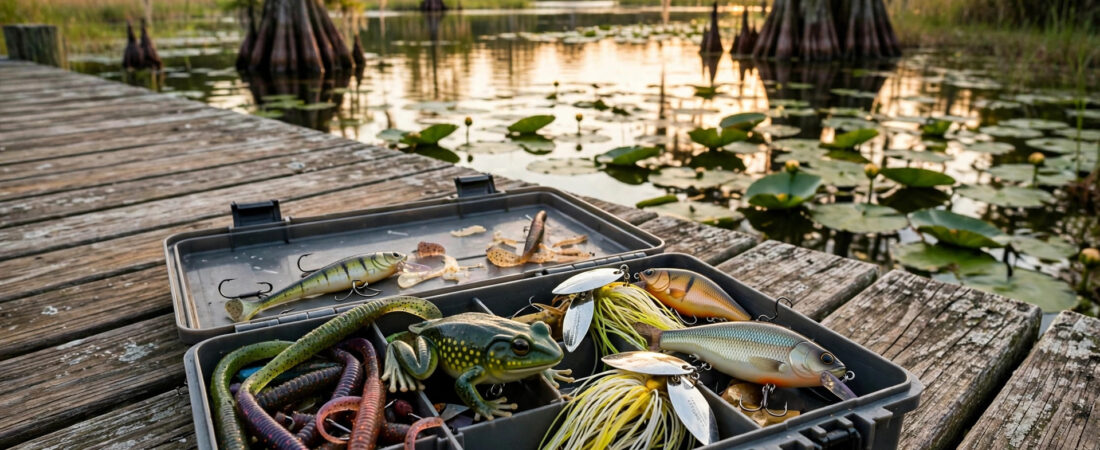
Florida freshwater fishing is a different animal from the salt. There are no tides to read and no oyster bars to shred your line — instead there’s grass. Miles of it. Kissimmee grass, hydrilla, lily pads, and matted cover so thick a bass can live its whole life under a canopy you’ll never see through. The angler who wins here is the one whose box is built for punching through that salad, skipping under cypress limbs, and switching in five minutes from a trophy largemouth to a mess of bluegill for the fryer. This is that box: the rods, reels, line, lures, and tools that actually earn their space on a Florida lake, river, or canal.
Everything below is organized the way a real trip unfolds: the box itself, the outfits you carry, the line that ties it together, hooks and terminal tackle, soft plastics, hard baits, panfish gear, live bait, and the tools that save the day. At the end there’s a quick checklist version and a starter build for new anglers. If salt water is more your speed, our companion guide — The Essential Florida Tackle Box: The Saltwater Edition — covers the flats, piers, and surf the same way. And before you load up, check today’s Florida fishing report for lake levels, river flows, and what’s biting in your region.
Start With the Box Itself
A freshwater tackle box lives a wet, muddy life — boat decks, canal banks, and the occasional dunk at the ramp. The old hard box with the latching lid still works fine on a jon boat, but most Florida freshwater anglers have moved to a soft waterproof tackle bag or a tackle backpack built around removable utility trays. The backpack wins for bank fishing the canals and walking the levees around Lake Okeechobee, because your hands stay free for rods and the net.
Inside, standardize on 3600-size waterproof tackle trays — four of them covers a full freshwater kit: one for hooks and terminal tackle, one for weights, one for hard baits, one for jigs and panfish gear. Keep soft plastics in their original bags, or better yet in a soft plastic bait binder — mixing brands in one compartment turns them into a melted science project in Florida heat, and a binder keeps your worms, creature baits, and swimbaits sorted by size and color instead of fused into one lump.
The Three Outfits That Cover Florida Fresh Water
You don’t need a rod locker full of gear. Three outfits cover nearly all of it — bass, specks, bream, and catfish, from the Kissimmee chain to the St. Johns River.
The do-everything spinning combo is the one you’ll fish 80 percent of the time: a 7-foot medium-power spinning combo with a 2500-size spinning reel. This is your bream-and-crappie rod, your weightless worm rod, your dock-skipping rod, and your general-purpose outfit for the Harris chain, the St. Johns, and the canals. Light enough to feel a bluegill tap a cricket, stout enough to horse a three-pound bass out of a lily pad edge. If you buy one good outfit, buy this one.
The bass baitcaster is the heavy-cover tool: a 6’6″ to 7-foot medium-heavy baitcasting rod and reel combo with a low-profile baitcaster. Florida bass fishing is a power-fishing game — flipping a creature bait into matted hydrilla, punching through kissimmee grass, dragging a frog across a lily pad field on Lake Okeechobee. A baitcaster gives you the winch power and the thumb control to stop a five-pound Florida-strain largemouth before it buries itself in the grass. This is the outfit that catches the fish of a lifetime, and the one that spends the most time in your hands from March through June.
The ultralight is the fun rod: a 5’6″ to 6-foot ultralight spinning combo spooled with 4- to 6-pound line. Bluegill and shellcracker on an ultralight fight like fish three times their size, and a mess of specks on light tackle is the purest fun in Florida freshwater. It doubles as your crappie rod around brush piles and bridge pilings, and it’s the outfit kids actually fall in love with fishing on. Don’t skip it — the panfish days are the days that keep you coming back.
Line and Leader: Built for Grass, Not Salt
Florida freshwater line choices start with one fact: the fish live in vegetation, and vegetation eats light line. Spool your baitcaster with 50-pound braided line as the everyday default — 65-pound when you’re punching mats or flipping heavy cover on Okeechobee or the Kissimmee chain. Braid has zero stretch, so a hookset at the end of a long cast into grass actually drives the hook home, and its thin diameter lets you winch a bass straight up through a pad field instead of watching it wrap you around a stem. The spinning combo gets 30-pound braid for the same reason, with a fluorocarbon leader when the water is clear.
Monofilament still earns its place: 10- to 12-pound monofilament is the right call for topwater walking baits and poppers (mono floats, so it doesn’t drag a lure’s nose down) and for crankbaits, where a little stretch keeps treble hooks from tearing out. And in the tannic, tea-colored water of the St. Johns River and the blackwater creeks of the Panhandle, a short leader of fluorocarbon leader line — 12-pound on the spinning rod, 20-pound on the baitcaster — disappears in the water and shrugs off abrasion from grass stems and cypress knees. Keep a few spools in the bag; Florida water changes color from lake to lake, and your leader should change with it.
Hooks: The Smallest, Most Important Purchase
Freshwater hooks are a short list, and every one of them earns its tray space. Stock EWG worm hooks in 3/0 and 4/0 — the extra-wide gap is what lets a fat stick bait or creature bait collapse and expose the point on the hookset, and it’s the standard Texas-rig hook from the Everglades to the Suwannee. For flipping and punching, add straight-shank flipping hooks in 4/0 and 5/0; the straight shank and heavy wire stand up to the violent hooksets and the grass-winching that Florida flipping demands.
Downsize for panfish: small bream hooks in size 6 and 8 for crickets and red wigglers, and light-wire Aberdeen hooks for crappie minnows under a bobber. And for catfish, circle hooks in 3/0 to 5/0 — a channel cat picks up a bait and swims off, the circle hook slides to the corner of the jaw, and you never have to set the hook at all. Buy hooks in corrosion-resistant finishes and replace any that show rust — a dull hook is the cheapest fish you’ll ever lose.
Weights and Terminal Tackle: The Grass-Fishing Tray
This is the unglamorous tray that catches most of the fish. Keep it stocked with:
- Tungsten worm weights in ¼ to 1½ ounces — tungsten is smaller and denser than lead, so it punches through matted vegetation instead of hanging up on top of it. A 1- to 1½-ounce tungsten weight is the Okeechobee punching standard.
- Bobber stops — the little rubber peg that holds your Texas-rig weight tight to the hook (or lets it slide, your call) and the same peg that sets the depth on a slip-bobber rig for specks.
- Split shot in BB to ⅜ ounce — for finesse rigs, for pinning a cricket just off the bottom for shellcracker, and for balancing a bobber rig in a canal current.
- Slip bobbers — the crappie and bream angler’s best friend. A slip bobber lets you fish a minnow or jig at any depth, from two feet over a brush pile to fifteen feet down a river channel, and it casts like a dream on light line. Carry a few sizes; the big ones double as shiner floats for trophy bass.
Soft Plastics: The Artificial Core
If you fish artificials for Florida bass, you fish soft plastics — and Florida bass eat them in every color of the rainbow, as long as it’s green pumpkin or black and blue. The four shapes that earn permanent bag space:
Stick baits in 5-inch sizes, fished weightless and wacky-rigged or Texas-rigged — the single most productive bass lure in Florida, full stop. A weightless stick bait fluttering down along a Kissimmee grass line is the closest thing to a guaranteed bite that exists. Ribbon-tail worms in 7- to 10-inch sizes, Texas-rigged on a 3/0 or 4/0 EWG — the ribbon tail pulses on the slowest retrieve, and big Florida-strain largemouth eat them in deep water, on ledges, and along the outside edges of hydrilla beds.
Creature baits — the bulky, many-appendaged plastics built for flipping and punching. Rigged on a straight-shank hook under a heavy tungsten weight, a creature bait is the lure that goes into the thickest mat on the lake and comes out with the biggest bass in it. And soft swimbaits in 3- to 5-inch sizes on a weighted hook or jig head — fished along grass edges, over submerged hydrilla, and through canal mouths, they imitate the shad and shiners that Florida bass hunt all year. Natural colors cover most water — green pumpkin, watermelon red, junebug — with black and blue for stained water and white for shad spawns.
Hard Baits: Frogs, Cranks, and Blades
Florida freshwater hard baits start with one lure: the frog. A hollow-body topwater frog walked across a lily pad field at dawn is the most exciting bite in Florida fishing — the explosion when a bass comes up through the pads is something you never forget. Frogs are a Florida staple because our lakes are full of the matted cover frogs were invented for. Carry white, black, and a natural green; walk it slow, pause it in the holes, and wait a full second after the blowup before you set the hook.
Round out the hard-bait tray with a squarebill crankbait for banging through stumps and cypress knees without hanging up, a lipless rattling crankbait for ripping through grass and burning over submerged hydrilla, and a spinnerbait in white and chartreuse for stained water, wind, and canal mouths. A chatterbait (bladed jig) belongs in the same tray — its thumping blade and pulsing skirt are deadly along grass lines and around dock pilings, especially in the spring. Finish with a walking topwater bait and a popper for the first and last hour of the day, when bass push baitfish to the surface over open water and the topwater bite is the best show on the lake.
Panfish and Crappie Gear: Specks, Bluegill, and Shellcracker
Florida’s panfish deserve their own tray, because the specks (black crappie) run and the bream beds are a fishery all their own. Stock crappie jigs in 1/32- to 1/8-ounce — tube jigs and curly-tail grubs in chartreuse, white, and pink — fished under a slip bobber or slow-trolled along a brush pile or bridge piling. A beetle spin is the classic Florida bream lure: a tiny jig head with a spinner blade, cast along a grass edge or a dock and reeled back slow, it catches bluegill, shellcracker, and the occasional surprised bass. And a few small inline spinners in 1/16- to 1/8-ounce round out the tray — they cast far on light line, flash in stained water, and catch everything that swims in a canal. The spring speck run on the St. Johns River and the Harris chain is one of Florida’s great fisheries; our weekly Florida Freshwater Report tracks the levels and the bite every Thursday.
Live Bait: Shiners, Crickets, and Catfish Bait
Florida freshwater runs on live bait, and the right bait depends on the fish. For trophy bass, nothing beats a wild shiner under a bobber — a big, lively shiner fished along a grass line or over a bed on Okeechobee or the Kissimmee chain is how most double-digit Florida bass are caught. Keep them in a bait bucket with a battery aerator, change the water when it clouds, and never leave the bucket in direct sun — a dead shiner catches nothing.
For bream, it’s red wigglers and crickets under a slip bobber on a size 6 hook — simple, cheap, and the way most Florida kids catch their first fish. A bed of bluegill in May will keep a whole family busy for an afternoon. And for channel catfish, the classics still work: stink baits and dough baits molded onto a treble hook, and chicken liver — messy, stinky, and absolutely deadly — fished on the bottom with a circle hook and a little patience after dark. Catfish are the night shift on the St. Johns and the Panhandle rivers, and they reward the angler who stays late.
Tools: The Tray That Saves Trips
Freshwater tools don’t face salt spray, but they still face mud, grass slime, and a season in a damp bag. The non-negotiables:
- Fishing pliers with a line cutter — hook removal, rigging, and a hundred jobs a trip. On a lanyard, because the lake claims a pair a season from somebody.
- Braid scissors — braid laughs at nail clippers and dull scissors; serrated braid shears cut it clean every time.
- A dehooker — faster releases, safer hands, and the difference between a clean release and a gut-hooked fish you didn’t mean to keep.
- A lip grip — controls a thrashing bass for the photo without putting your thumb in its mouth, and settles every dockside argument about the catch.
- A measuring board — Florida bass have slot and bag limits that vary by water, and specks have a 25-fish bag limit; measure, then decide. Check current FWC rules before you go.
- A rubber-mesh landing net — rubber mesh doesn’t eat hooks or strip slime off fish you’re releasing, and it saves the heartbreak of a boatside loss on the fish of the day.
Last, the most underrated “tackle” in Florida: polarized sunglasses with amber or copper lenses. Spotting bass beds in the shallows, reading grass edges, watching a frog disappear in a pad-field explosion — none of it works without them. They are a fishing tool, full stop.
The One-Box Checklist
Print this in your head before every trip. If it’s all in the bag, you’re ready for anything Florida fresh water throws at you:
- Spinning combo (7 ft medium, 2500 reel) + baitcaster (6’6″–7′ medium-heavy) + ultralight for panfish
- Braid on the reels (30 lb spinning, 50–65 lb baitcaster); mono for topwater and cranks; fluorocarbon leaders
- EWG worm hooks 3/0–4/0, flipping hooks 4/0–5/0, bream hooks size 6–8, circle hooks 3/0–5/0
- Tungsten worm weights, bobber stops, split shot, slip bobbers
- Stick baits, ribbon-tail worms, creature baits, swimbaits
- Hollow-body frogs, squarebill and lipless crankbaits, spinnerbaits, chatterbaits, walking topwaters, poppers
- Crappie jigs, beetle spins, small inline spinners
- Live bait: wild shiners, red wigglers, crickets; stink or dough bait and chicken liver for catfish
- Pliers, braid scissors, dehooker, lip grip, measuring board, landing net
- Polarized sunglasses — and your license (check current FWC rules before you go)
Starting From Zero: The Budget Build
New to this? Don’t buy the whole list. The honest starter kit is the 7-foot medium spinning combo, a spool of 30-pound braid, 12-pound fluorocarbon leader, a pack of 4/0 EWG hooks, tungsten weights and bobber stops, stick baits and ribbon-tail worms, one hollow-body frog, a couple of crappie jigs, pliers, and braid scissors. That kit fishes the canals, the docks, the grass edges, and half the lakes in Florida — and it grows one tray at a time from there. Our weekly Florida Freshwater Report will tell you where the water is and what’s biting, and today’s report covers the daily picture.
A Word on Care
Florida fresh water is easier on gear than salt, but it isn’t kind. Rinse rods and reels after every trip — lake water leaves a film, and hydrilla slime in a reel is a slow death. Dry trays before you close them, or hooks rust in the damp. Toss soft plastics that have been chewed up or sun-baked; a torn worm catches nothing. And sharpen or replace hooks often — dragging a frog through lily pads dulls a point faster than you’d think, and a dull hook is the cheapest fish you’ll ever lose. Ten minutes of care after the trip is the difference between a five-year reel and a one-season reel.
Build the box once, build it right, and the only thing left to worry about is the weather — and we’ve got that covered every morning in today’s report. Tight lines.
This post contains affiliate links. If you buy through them, The Florida Bite may earn a small commission at no extra cost to you — see our Affiliate Disclosure.